
In Italy the roll-out of fibre optics is still in its early stages, and the number of sites for laying the cables can be expected to grow further in 2022. Road-works companies are therefore called upon to make operational choices that also have a “strategic” dimension: the excavation techniques they use and the type of machines they have determine the number of sites they can manage.
Traditional excavation
Working in the traditional way, i.e. with a mini excavator fitted with a trencher wheel, produces trenches 6 to 10 centimetres wide which, after the cables have been laid, have to be filled with specific materials, such as concrete with admixtures.
In addition, the trencher wheel works dry and, unless it is kept constantly cooled, is likely to have a very short life (20-30 metres of use).
On medium-sized sites, this extends working times. So working times normally of no less than 4 hours for cuts of approx. 20 metres, technical downtime, plus transporting and setting up the equipment: all of this has an impact on the overall budget.
Even more “micro” micro-trenches
The micro-trenching technique is less invasive and faster, as the backfill material required is reduced to as little as 1/5 compared with traditional excavation, and waiting times between operations are eliminated.
Sea Technology’s SEAFLOOR 501 floor saw makes micro-trenches even more “micro”. Many operators choose to pair it with the 500 mm diameter, 20 mm cutting width grooving blade, but the 450 diameter, 15 mm width blade also hits the target perfectly.
Fibre-optic ducts are in fact up to 14 mm in diameter and can therefore be inserted simply and safely into a micro-trench 16 mm wide, with an even higher floor saw travel speed and a further reduction in backfill material.
In this way, a couple of hours’ work can be enough to set the machine down on the ground (the dedicated handle makes loading and unloading from the van and handling easier), cut the micro-trenches, lay the ducts and close the trench.
In addition to these operational advantages, there are financial ones: the budget needed to set up a traditional excavation (hire of a mini excavator, trencher wheel and a tipper vehicle for transport to site) is comparable to the purchase cost of the Sea Technology solution.
These are aspects that all companies wishing to seize the opportunities offered by this expansionary phase of the market should weigh carefully: an extremely affordable investment that, in the same amount of time, makes it possible to handle a greater number of jobs on site, with clear benefits for turnover.
For further information on our solutions for fibre-optic sites, contact Sea Technology’s distributors across Italy, or get in touch with us to be referred to the agent nearest you.
Gallery
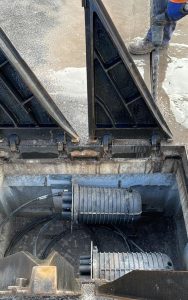
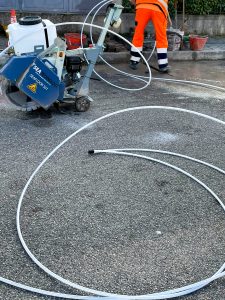
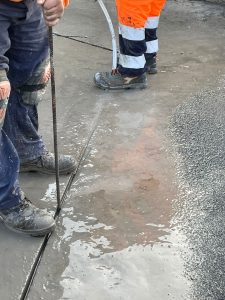
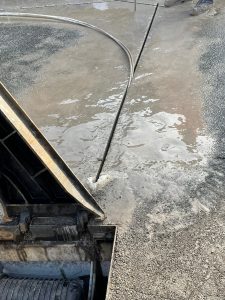
The images show a recent site where the SEAFLOOR 501 floor saw was paired with the 450 mm diameter, 15 mm cutting width grooving blade.
The entire job took approx. 2 hours.